Wearable biomechanics
Estimating 3D foot kinetics from wearable signals
How much of the force and moment profile measured by an instrumented treadmill can be recovered from insole signals?
IEEE Journal of Biomedical and Health Informatics · 2026 (online 2025)
- Smart-insole pressure signals
- Estimated forces and moments
- Comparison with treadmill measurements
Approach
Ke2KeNet uses time series from 16 insole pressure sensors per foot. The study trained separate models for three force components, three moment components, and two centre-of-pressure coordinates, then compared the estimates with treadmill recordings across walking and running speeds.
Reported results
For the average gait cycles in Table I, the reported Pearson correlation exceeded 0.95 for all target signals except the right-foot vertical moment.
- Healthy participants in cross-validation
- 9
- Subject-independent folds
- 5
- Estimated signals per foot
- 8
My contribution
I led preprocessing, model development, subject- and speed-wise evaluation, analysis, and manuscript preparation.
Study scope
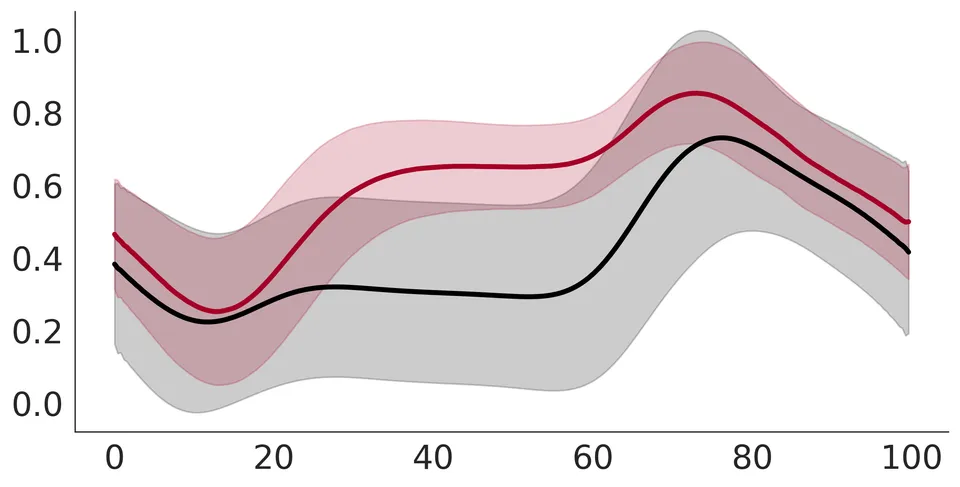
The results come from nine healthy participants under controlled treadmill conditions. The plot illustrates one participant’s walking trials and shows where the estimated moment departs from the reference.
Ongoing work
I’m investigating how to combine plantar sensing with inertial measurements from the foot and shank, and how well models transfer across datasets.
Mediolateral ground reaction moment
Normalized amplitude (unitless)
Gait cycle (%)
Run the insole workflow
Use Python 3.12 and the tagged code release v0.1.0. The demo uses a small U-Net and synthetic signals to exercise the insole workflow on CPU without study data or pretrained weights.
Get the release
git clone --branch v0.1.0 --single-branch https://github.com/Sakib1263/Unimodal-3D-Kinetics-Estimation-from-Insole-or-IMU.git
cd Unimodal-3D-Kinetics-Estimation-from-Insole-or-IMU
Install and run the demo
Create an environment with
python -m venv .venv. Activate it withsource .venv/bin/activateon Linux or macOS, or.\.venv\Scripts\Activate.ps1in PowerShell. Then run the following commands.python -m pip install -r requirements.txt python -m kinetics demo --config configs/insole.jsonCheck the output
The command prints
Saved run: …/runs/demo_Fy_LL_UNet_…. Open that directory and check thatstatus.jsonreports"status": "complete". The run also writessummary.jsonand fold-level predictions. Those results describe synthetic inputs.
Work with the study data
The processed treadmill and insole recordings are publicly downloadable. Use the data preparation guide to create the expected input files. Then inspect the target, scale, and participant splits before training.
python -m kinetics inspect --config configs/insole.jsonThe release contains the maintained workflow. The article’s training-ready exports and pretrained checkpoints are separate from the release.